

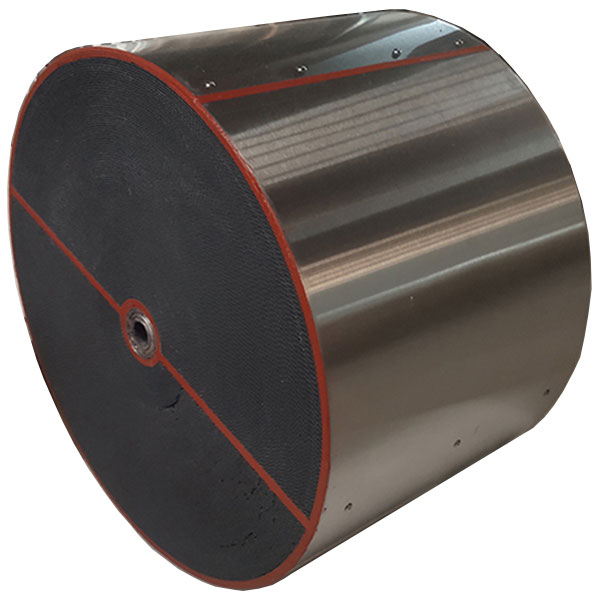
Polymer Dehumidification Rotor with a Minimum Regeneration Temperature of 35°C
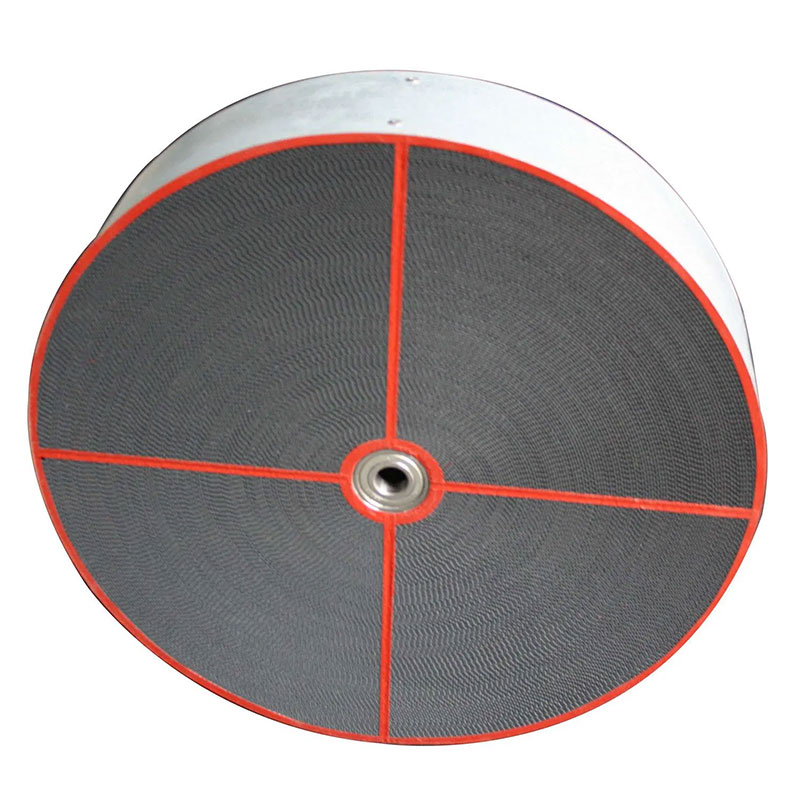
Product Description
"Global Carbon Neutrality" and "Energy Saving" are unavoidable issues for all companies and individuals today, so we need to use more
advanced energy-saving and low-carbon technologies than those currently available. Dehumidifying air conditioners and dehumidifiers are
among the most focused technologies in "energy-saving and low-carbon technologies." In the field of air treatment, the current dehumidification
methods on the market are basically condensation low-temperature dehumidification and traditional rotor dehumidification; however, condensation
low-temperature dehumidification requires extremely low temperatures and consumes a lot of energy (in special places heating is also needed to
adjust the temperature); traditional rotor (silica gel, molecular sieve) achieve dehumidification effects while requiring high temperatures of 100°C~150°C
for regeneration which consumes a lot of energy.
Therefore, we successfully developed a low-temperature regenerative rotor using room temperature moisture-absorbing materials: a polymer adsorbent
that can achieve low-temperature regeneration at 35-70 degrees Celsius. It can achieve deep dehumidification even in low-temperature environments
(-35 degrees Celsius), and regeneration can be achieved using idle energy such as waste heat from heat pumps. It is also suitable for ordinary air
conditioners without high-temperature heat sources (such as in residential buildings and public places) and for industrial production applications
(in industries such as food, pharmaceuticals, and electronics).
The combination of heat pumps and polymer rotors has produced unprecedented air conditioning equipment, saving 35%~70% energy and
more effectively addressing issues such as carbon neutrality, carbon peaking, energy conservation, CO2 reduction, global warming and
ozone layer depletion.
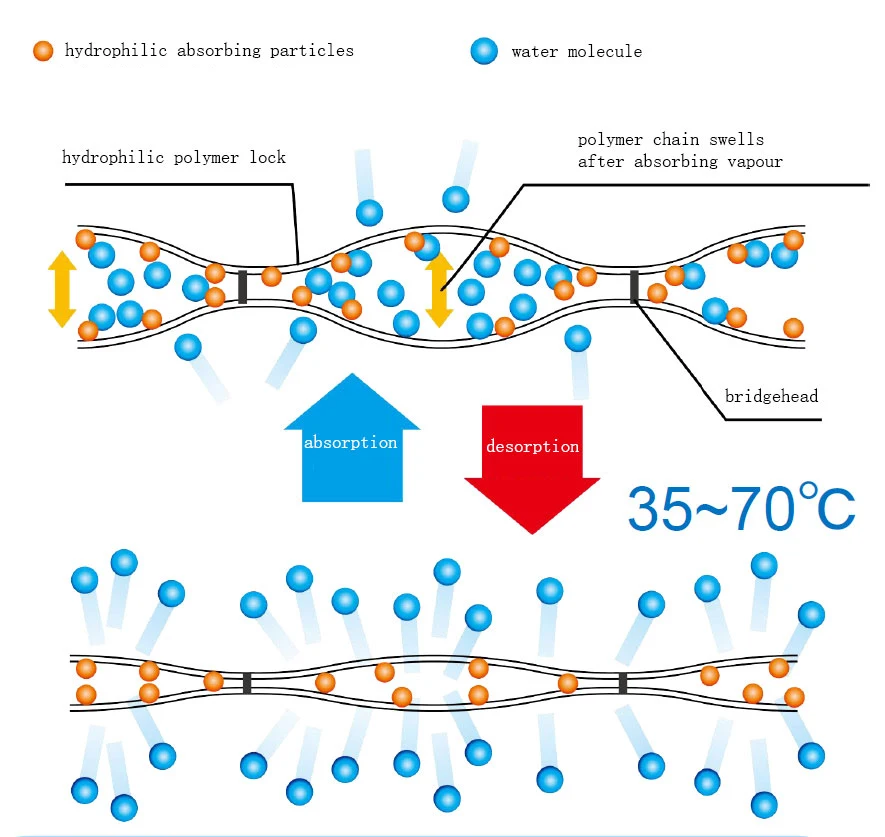
Polymer Adsorption Principle
• Water vapour is absorbed, causing polymer chains to swell to retain a large amount of water.
• During desorption, water vapour is released and polymer chains contract.
• The soft polymer chains follow the swelling and contraction, achieving excellent durability.
Polymer Rotary Rotor Dehumidification Process
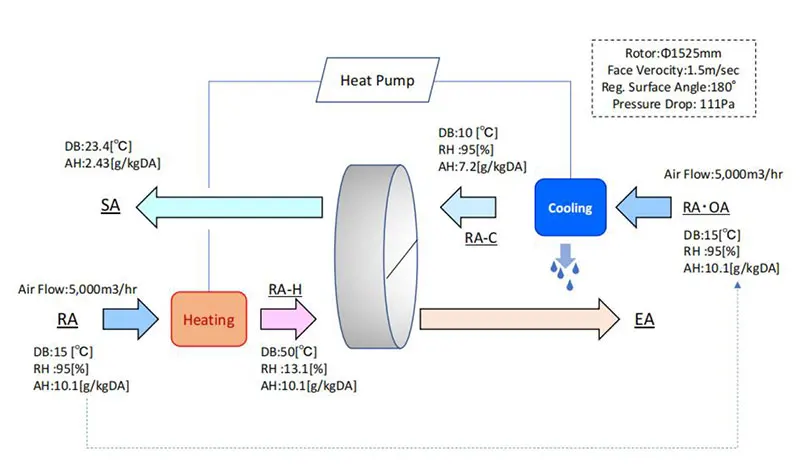
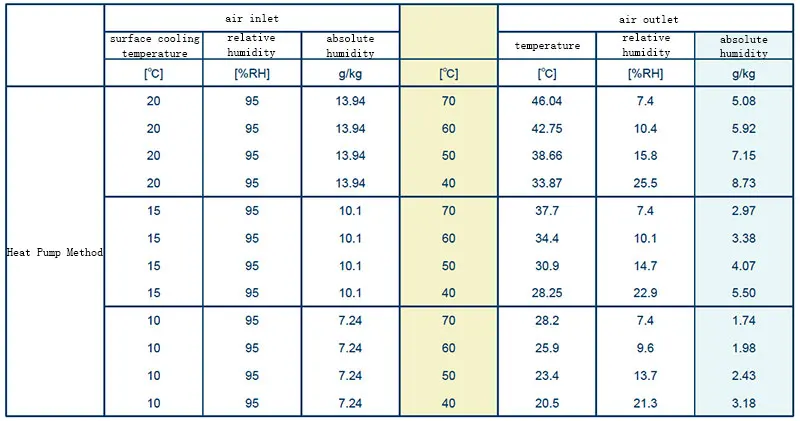
Low-temperature dehumidification wheel dehumidification effect
rotor diameter: 1525mm depth: 200mm airflow: 5000Nm3/h
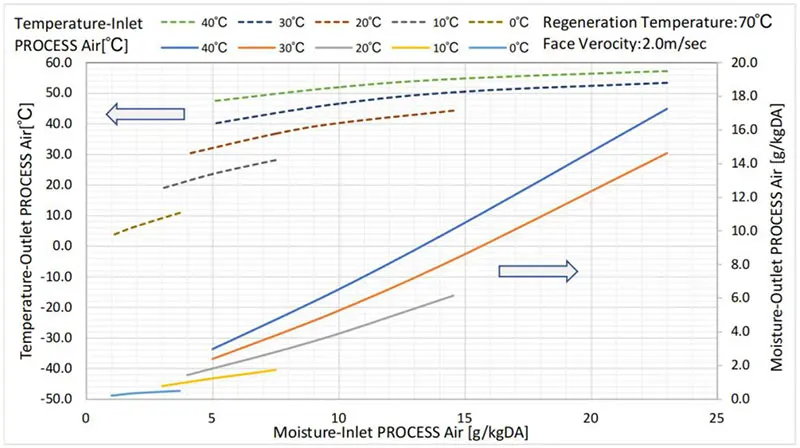
Performance Curve of Polymer Rotary Dehumidifier
Conventional Zize of Polymer Dehumidifying Rotor
| Product Model | Product Size | Air Volume (CMH) | ||
| (mm) | 1.5m/s | 2.0m/s | 2.5m/s | |
| ZWG770-200 | 770*200 | 1200 | 1500 | 2000 |
| ZWG965-200 | 965*200 | 1900 | 2600 | 3200 |
| ZWG1050-200 | 1050*200 | 2300 | 3000 | 3800 |
| ZWG1250-200 | 1250*200 | 3300 | 4300 | 5400 |
| ZWG1370-200 | 1370*200 | 3900 | 5200 | 6500 |
| ZWG1525-200 | 1525*200 | 4900 | 6500 | 8100 |
| ZWG1730-200 | 1730*200 | 6300 | 8400 | 10500 |
| ZWG2000-200 | 2000*200 | 8400 | 11200 | 14000 |
| ZWG2200-200 | 2200*200 | 10200 | 13600 | 17000 |
| ZWG2500-200 | 2500*200 | 13200 | 17600 | 22000 |
Product Application
The low-temperature regenerative rotor dehumidifier can quickly, simply and effectively reduce air humidity, efficiently addressing
dehumidification requirements that cannot be achieved by other refrigeration methods under normal low humidity or low temperature
low humidity conditions. It is widely used in industries with strict humidity requirements such as food and beverage, pharmaceuticals,
electronics, chemicals and printing.